

If you’ve just left a large consulting firm or organisation, your instinct will be to replicate what you know.
Formal proposals.
Complex deliverables.
Layered service menus.
Long scoping documents.
You assume professionalism equals complexity.
It doesn’t.
For established consultants building an independent practice, complexity is often the fastest route to revenue volatility, burnout, and zero time freedom.
If your goal is higher income, more leverage, and actual freedom, you do not need more services.
You need better revenue architecture.
The Real Goal Is Not Scale. It Is Stability.
Most experienced consultants make the same mistake in the first 12 to 24 months.
They chase scale before they stabilise income.
They launch courses.
They experiment with memberships.
They build funnels.
They create multiple service tiers.
All while their core revenue is unpredictable.
Time leverage and financial leverage are built on stability. Not ambition.
Before you scale revenue, you stabilise revenue.
You Do Not Have a Corporate Infrastructure
Large firms operate on advantages you no longer have:
- Brand equity
- Institutional trust
- Procurement pipelines
- Deep benches of staff
- Multi-layer pricing models
You have something else.
Expertise.
Reputation.
Judgment.
Relationships.
Trying to replicate a Big Four operating model as a solo consultant is misalignment.
It looks impressive.
It feels heavy.
It destroys margin.
Independent consulting businesses must be proportionate to capacity.
Not to ego.
Not to history.
Not to your previous employer.
The First Pain Point: Revenue Volatility
When established consultants struggle after leaving corporate roles, it is rarely a competence issue.
It is a structure issue.
Two common patterns:
- Underpricing because they feel “new” as an independent.
- Overcomplicating offers to prove credibility.
Both destroy financial leverage.
Revenue stability does not come from adding more services.
It comes from clarifying what you are paid for.
Not activity.
Not effort.
Not hours.
Impact.
Shift 1. From Hours to Outcomes
Corporate billing trains you to think in time.
Independent wealth is built on outcomes.
Clients are not buying:
- Your hours
- Your reports
- Your slide decks
They are buying:
- Risk reduction
- Strategic clarity
- Regulatory confidence
- Commercial advantage
When you package hours, you cap your income.
When you package outcomes, you unlock pricing power.
Outcome-based positioning is the first step toward financial leverage.
Shift 2. From Service Menus to Core Revenue Anchors
Most independent consultants operate with:
- Too many services
- Too much customisation
- Too much scoping
This fragments revenue and consumes time.
You do not need ten services.
You need one to three structured core offers.
For example:
- A paid strategic diagnostic
- A defined 90-day advisory engagement
- A structured retainer
These are revenue anchors.
They create predictability.
Predictability creates financial leverage.
Financial leverage creates breathing room.
And breathing room creates time leverage.
Shift 3. From Immediate Scale to Sequential Growth
Here is where experienced consultants burn cash.
They believe leverage equals digital products.
So they build:
- Online courses
- Group programmes
- Membership communities
- Automated funnels
But digital scale requires:
- Audience trust
- List depth
- Clear positioning
- Marketing infrastructure
Without stable core revenue, these become distractions.
Time leverage is not created by adding more moving parts.
It is created by designing a model that does not require your constant presence.
Stability first.
Systemisation second.
Scale third.
The sequence matters.
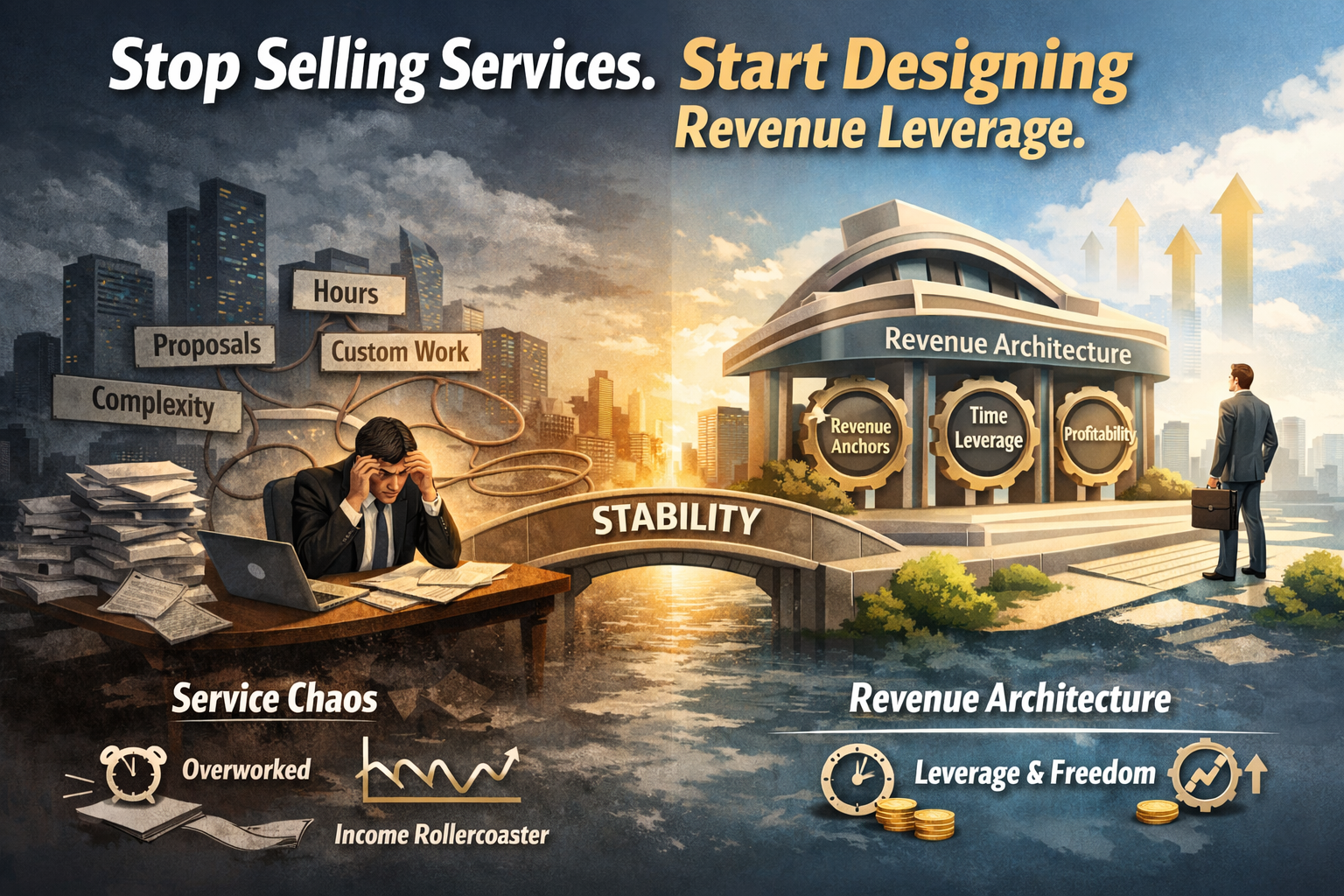
The Revenue Leverage Framework for Established Consultants
If you want to increase consulting revenue without increasing workload, focus here.
Step 1. Define Your Primary Revenue Anchor
Your revenue anchor must:
- Solve a high-value problem
- Be deliverable without a large team
- Generate meaningful cash flow
- Be repeatable
This is not your “entry-level” offer.
This is your commercial foundation.
Without a revenue anchor, income will always fluctuate.
Step 2. Price for Financial Leverage, Not Survival
If your pricing only covers personal expenses, you have built a fragile business.
Sustainable consulting pricing must account for:
- Tax obligations
- Reinvestment
- Buffer months
- Strategic downtime
Underpricing forces constant client acquisition.
Constant acquisition eliminates time leverage.
And without time leverage, freedom is impossible.
Step 3. Design for Time Leverage From Day One
Freedom is not accidental.
It is engineered.
Your core offer should:
- Be structured and repeatable
- Limit unnecessary custom work
- Avoid 60-hour delivery weeks
- Be capable of delegation or systemisation
Every engagement should move you closer to optionality.
Not deeper into dependency.
If your business requires you to be constantly available, you have built employment. Not leverage.
You Are Not Building a Firm. You Are Building Revenue Architecture.
Large firms optimise for:
- Market dominance
- Scale
- Hierarchy
- Headcount
Independent consultants should optimise for:
- Profit margin
- Control
- Time ownership
- Strategic growth
These are different objectives.
They require different structures.
Established consultants who design for leverage earn more with fewer clients.
They work fewer hours per pound earned.
They stop selling services.
They start designing revenue systems.
When to Scale
Only explore scale once revenue is:
- Predictable
- Profitable
- Structurally controlled
Then you can build:
- Thought leadership
- Intellectual property
- Digital products
- Licensing models
But if you scale before stabilising, you amplify instability.
Scale without structure increases stress.
Structure without vision creates stagnation.
The order determines the outcome.
The Hard Question
Is your consulting business structured for:
Impressiveness.
Or leverage.
If revenue rises only when your hours rise, you do not have financial leverage.
If income drops when you rest, you do not have time leverage.
Established consultants who redesign their commercial model unlock both.
Architecture before amplification.
Design the revenue engine.
Then scale it.