Business owners often use the words growth and scaling as though they mean the same thing.
They don’t.
Both are intended to increase revenue, but they do so in different ways. Neither growth nor scaling guarantees increased revenue.
Both can create larger businesses. But they require completely different strategies, different systems and, perhaps most importantly, a different way of thinking.
Understanding the difference helps you make better decisions about where you’re trying to take your business.
Growing a business
Growth usually means increasing the size of your business by adding resources.
More people. More products. More locations. More customers. More marketing.
Imagine you own a beauty brand that sells shampoo. To grow, you might introduce conditioners, hair oils, body wash and skincare. You hire additional staff, rent a larger warehouse and increase your advertising budget.
Consider a service-based company such as corporate training. To serve more clients, you hire additional facilitators and administrators. You deliver more workshops and generate more revenue, but every new contract requires more people, preparation and delivery time.
Or imagine you own a Caribbean food company with one successful pepper sauce. To grow, you introduce new flavours, add marinades and seasonings, employ more production staff and purchase more equipment.
In both cases, revenue may increase, but costs and operational demands rise with it.
There is nothing wrong with this approach. Many strong businesses grow steadily by adding resources as demand increases.

Scaling a business
Scaling begins with a different question.
Instead of asking, “What else can we add?”, you ask, “How can we enable what already works to serve many more people?”
Rather than launching five new products, you ask how your bestselling shampoo could become the preferred brand in every household across your country, then across the Caribbean, the UK and eventually international markets.
The training company might standardise its most successful programme, convert part of it into digital learning, license the content to organisations and certify other facilitators to deliver it. The company can now reach thousands of learners without its internal team personally delivering every session.
The food company might focus on its bestselling pepper sauce, contract a certified manufacturer, improve its packaging and negotiate distribution agreements in the Caribbean, the UK and North America. Production costs will still increase, but the company does not need to build and manage every part of the expanded operation itself.
Scaling is not simply about adding more.
It is about creating systems, partnerships and assets that allow revenue and reach to increase faster than internal costs and complexity.
That may require:
- Standardised processes
- Automation
- Licensing
- Franchising
- Technology
- Strategic partnerships
- Contract manufacturing
- Stronger distribution
- Intellectual property that can be sold or delivered repeatedly
Scaling multiplies what already works.

A lesson I learned at fifteen
One of my earliest jobs after high school was at a garden centre, landscaping and pest control company on the island of St. Maarten.
Many of our clients owned large villas or hotels, and every year one particular customer would hand me a blank cheque.
When all the work was finished months later, we’d simply write in the final amount.
I remember asking who this client was.
My boss smiled and said, “He owns a company that makes nuts.”
Not nuts and bolts.
Just the nut.
Specifically, one particular nut used on one particular type of vehicle.
That company had become extraordinarily successful by becoming exceptionally good at one thing.
It wasn’t trying to manufacture every part of the car.
It focused on one component and supplied it at scale.
That lesson has stayed with me ever since.
Scale often comes from doing fewer things exceptionally well, not more things reasonably well.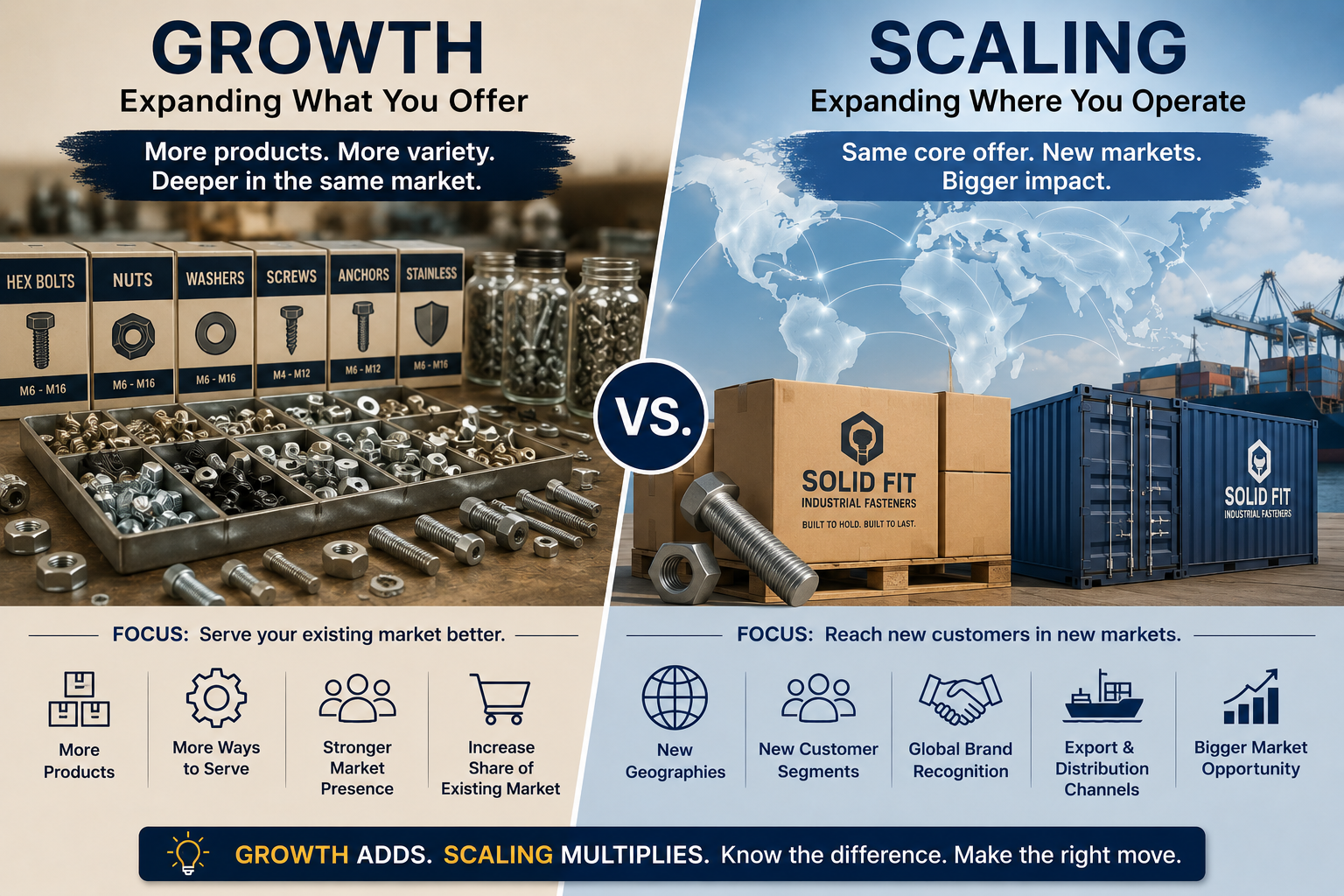
The leader has to change too
Scaling is not only a business strategy. It also changes what the business requires from its leader.
A growing business may need the founder to become a better manager. A scaling business needs the leader to become a better architect of people, systems, capital and opportunity.
The question changes from:
“How can I work harder to produce more?”
to:
“How do we build a business that can produce more without everything continuing to depend on me?”
That transition is not automatic.
The skills that helped someone start a business may not be the skills needed to lead it at five or ten times its current size. A strong salesperson may not know how to design an organisation. A highly creative founder may struggle to establish processes or manage senior executives. A leader who built the business by controlling every decision may find it difficult to give others genuine authority.
Recognising those limitations is part of leadership.
The leader may need to:
- Work with a coach or experienced adviser who can challenge their assumptions.
- Read and learn more about finance, systems, organisational design and leadership.
- Hire executives or specialists with capabilities the existing team does not have.
- Give those people the authority to make decisions.
- Replace informal ways of working with documented processes and clear accountability.
- Stop offering products or services that create activity but cannot be delivered profitably at scale.
- Become comfortable investing in capacity before the full financial return is visible.
- Step away from work that provides personal satisfaction but keeps the business dependent on them.
This can be uncomfortable. Scaling may expose gaps in the leader’s knowledge, reveal weaknesses in the existing team and require changes to roles and relationships that have existed since the company began.
The leader’s job is no longer to be the person who solves every problem.
It is to build the team, systems and decision-making structure through which problems can be solved without everything returning to them.
That is the real shift from operator to architect.

Which path should you choose?
Neither is inherently better.
Some businesses should grow steadily for decades.
Others have business models that allow them to scale once demand, delivery and financial capacity have been proven.
Scaling does not have to be rapid. Attempting it too early can magnify weak demand, poor margins and unreliable systems.
The mistake is pursuing one strategy while believing you’re following the other.
If every increase in revenue requires proportionally more staff, more hours and more expenses, you’re growing.
If revenue can increase dramatically without matching increases in costs because you’ve built leverage into the business, you’re scaling.
Know which game you’re playing.
Because the strategies, investments and leadership required for each are entirely different.
Growth builds a bigger business by adding resources.
Scaling builds greater reach by multiplying what already works.
Both can be successful. But they require different investments, different systems and different leadership.
Know which one you are pursuing before you commit the people, money and time required to achieve it.