In my previous article Growth isn’t Scaling, I explained the difference between growing a business and scaling one.
Growth is about adding resources. Scaling is about multiplying what already works.
I used two examples.
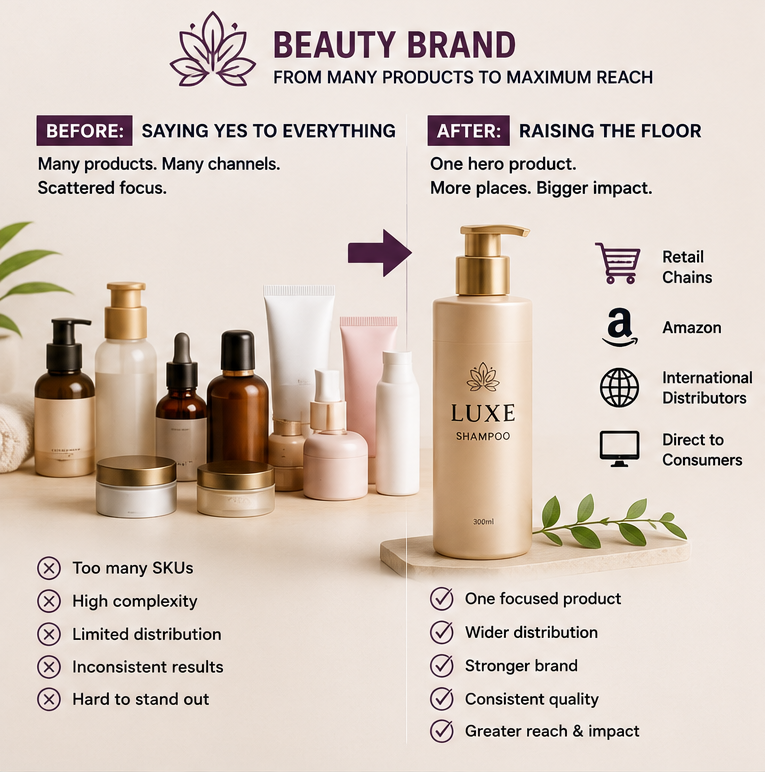
A beauty company grows by introducing shampoo, conditioner, body wash and skincare. It employs more people, holds more inventory and spends more money marketing an expanding product range.
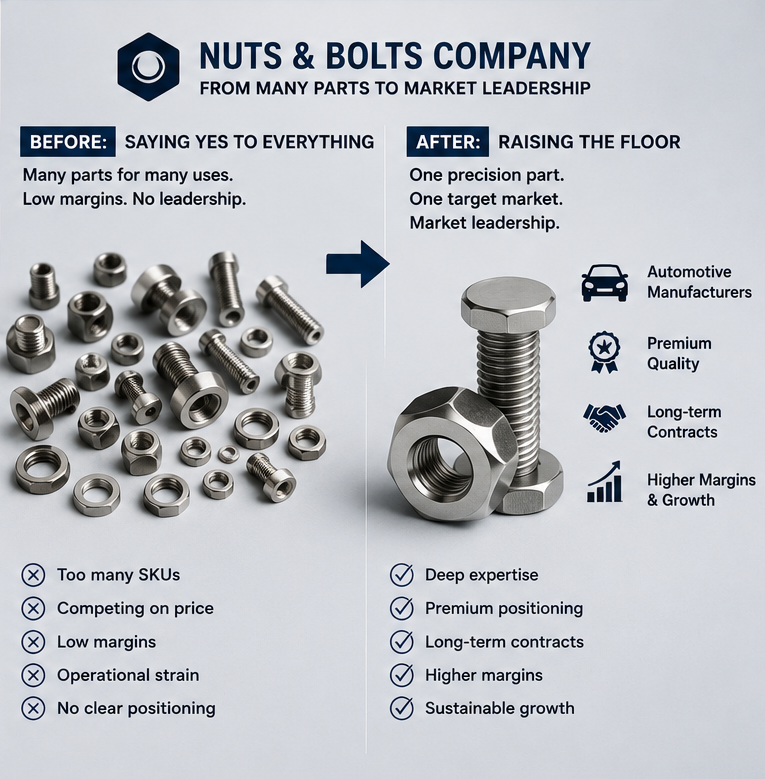
A specialist manufacturer takes a different route. Instead of producing every type of nut and bolt for multiple industries, it focuses on one component for the automotive sector and becomes exceptionally good at producing it consistently and in volume.
The same can be seen in a training company.
The training company grows by winning more contracts and hiring additional facilitators to deliver them. It scales by standardising its strongest programme, converting part of it into digital learning, licensing its intellectual property and certifying other facilitators to deliver it.
A Caribbean-themed food company might grow by adding more pepper sauces, marinades and seasonings. It scales by focusing on its bestselling sauce, standardising the product and using contract manufacturing and distribution partners to reach international markets.
In every example, the strategy changes.
But before the strategy can change, the leader must change.
Scaling is not simply about building better systems. It requires the founder or chief executive to become a different kind of leader.
1. Think Bigger. Choose Greatness.
One of the central ideas in The Science of Scaling by Dr Benjamin Hardyand Blake Erickson is that a substantially bigger goal requires a different strategy.
A founder building a £500,000 business will ask different questions from a leader designing a £10 million company.
The £500,000 question may be: How can we sell more of what we currently offer?
The £10 million question is more likely to be: What would need to be true for this business to serve ten times as many customers without becoming ten times as complicated?
That question forces different decisions.
If £10 million is genuinely the objective, some products, services and clients may no longer belong in the business. They may be profitable, enjoyable or familiar, but still consume resources needed for the larger vision.
The beauty brand stops thinking only about selling at local markets. It considers national retailers, ecommerce platforms and international distribution.
The manufacturer stops accepting orders from every industry and concentrates on becoming a trusted supplier to automotive companies.
The training company stops treating every contract as a completely customised assignment. It identifies which programme solves a common, valuable problem and can be standardised for a larger market.
The Caribbean food company stops assuming that expansion requires ten new products. It asks whether its strongest sauce could reach ten new markets through better manufacturing and distribution.
This is where the leader’s development becomes important.
Thinking bigger does not mean making louder declarations or choosing an ambitious revenue target without evidence. It means developing the ability to understand larger markets, more complex financial decisions, strategic partnerships, organisational design and risk.
The leader may need to read more widely, work with a coach or adviser, learn from executives who have scaled comparable businesses or join communities where larger decisions are being made.
You cannot lead towards a future you are unwilling to learn about.
2. Simplify to Amplify
Many founders assume scaling means doing more.
More products. More services. More markets. More channels.
In reality, scaling often begins by doing fewer things with greater precision.
The beauty company stops trying to launch twelve products and concentrates on making its strongest shampoo the preferred choice for a clearly defined customer.
The manufacturer stops producing hundreds of unrelated fasteners and builds its reputation around one specialised automotive component.
The training company stops creating a new course for every client. It develops one core programme with a clear methodology, defined outcomes and a delivery model that other facilitators can reproduce.
The Caribbean food company stops tying up cash in small quantities of multiple sauces. It directs its investment towards increasing production and distribution of its proven bestseller.
Focus creates leverage. Complexity consumes it.
This can be difficult for founders because many of the products and services exist for understandable reasons. A client requested something. A new opportunity appeared. A team member had an idea. Revenue was needed, so the business said yes.
Over time, those individual decisions create a company that is active but difficult to explain, sell and operate.
Simplification requires the leader to separate personal attachment from commercial value.
- Which offer produces the strongest results?
- Which customers receive the greatest value?
- Which part of the business has the potential to grow without creating equal growth in costs and complexity?
- Which activities would we stop if we were building this company again today?
The answers may reveal that the company does not need another product. It needs the discipline to commit to the right one.
3. Build Systems, Not Heroics.
Scaling cannot depend on the founder remembering everything, approving everything or rescuing every situation.
It depends on systems.
A business becomes more prepared for scale when it has:
- Documented processes
- Defined roles and decision-making authority
- Consistent training
- Quality-control standards
- Checklists and decision frameworks
- Technology supporting repeatable tasks
- Reliable financial and performance data
- Clear procedures for handling problems
Every important process that exists only in someone’s memory creates risk.
The training company cannot license its programme if its quality depends entirely on how the founder delivers it. The methodology must be documented. Facilitators must be trained. Assessment criteria must be clear. Participants should receive a consistent experience regardless of who delivers the programme.
The food company cannot enter new markets if each batch of sauce depends on the founder personally adjusting the recipe. Ingredients, measurements, preparation, testing, packaging and quality control must be standardised.
The beauty brand cannot scale through retailers if packaging, inventory and fulfilment are managed through improvised spreadsheets and last-minute messages.
The specialist manufacturer cannot win major automotive contracts if the quality of its component changes depending on who is working that shift.
Memory does not scale. Systems do.
This is where many founders struggle because the business is deeply personal.
You made the sacrifices. You carried it through difficult periods. You solved the crises. Clients trust you. The team still turns to you because you have always been the person with the answer.
But the behaviour that helped the business survive can eventually prevent it from scaling.
The founder must move from being the person who solves every problem to the leader who builds the system through which problems are solved.
That requires extracting knowledge from the founder’s head and making it accessible to the organisation.
It also requires intentional trust.
Delegation does not mean handing someone a task while retaining every decision. It means establishing the expected result, defining the boundaries and giving a capable person the authority to deliver.
4. Build the Leadership Capacity the Future Business Needs
The person who successfully started the company is not automatically equipped to lead it at ten times its current size.
That is not an insult. It is a leadership reality.
A founder may be an exceptional product developer but have limited experience with distribution. A gifted trainer may not know how to protect and license intellectual property. A creative beauty entrepreneur may not understand retail negotiations or supply-chain management. A food producer may need specialist support to meet the regulatory standards of international markets.
Scaling exposes capability gaps.
The leader has several options:
- Learn the skill.
- Work with a coach or adviser.
- Hire someone who already has the skill.
- Develop an existing team member.
- Form a strategic partnership.
- Decide that the capability does not belong inside the company.
The right answer will depend on how critical the capability is and how often it is needed.
The beauty brand may need a retail distribution specialist rather than another social media assistant.
The manufacturer may need an experienced quality-assurance leader who understands automotive standards.
The training company may need an instructional designer, licensing specialist or digital platform partner rather than another facilitator.
The food company may need an operations leader or manufacturing partner with experience in export compliance, food safety and international distribution.
Hiring more people is not the same as building the right team.
Scaling requires leaders to look beyond the immediate workload and ask which capabilities the next version of the business will require.
It may also require changes to the existing team.
Some people who were valuable during the start-up stage will grow into the next stage. Others may be strong performers but better suited to the earlier version of the company. Roles that were informal may need clearer accountability. Leaders who once managed tasks may need to manage teams and budgets.
Avoiding those decisions does not protect the culture. It transfers the cost of indecision to everyone else.
Scaling is rarely a solo achievement. It requires capable people who can think, decide and lead without waiting for the founder.
5. Raise the Floor
Another principle from The Science of Scaling is the importance of raising the floor.
Leaders often focus on raising the ceiling. They ask how the business can achieve its best-ever sales month, win its largest contract or enter its biggest market.
Scaling requires another question: What is the minimum standard we are willing to accept?
Raising the floor improves the baseline performance of the entire business.
The weakest customer experience becomes better. The slowest response becomes faster. The least experienced employee receives better training. The quality of an ordinary day begins to look more like the quality of the company’s best day.
For the beauty brand, raising the floor might mean:
- Every product meets the same ingredient and safety standards.
- Every retail order is dispatched within an agreed period.
- Every package reflects the same level of quality.
- Every customer complaint follows the same resolution process.
For the specialist manufacturer, it might mean:
- Every component meets the required tolerance.
- Every batch is traceable.
- Every quality issue triggers a documented response.
- Every employee follows the same safety and production procedures.
For the training company, it might mean:
- Every facilitator completes the same certification.
- Every participant receives the same core learning outcomes.
- Every programme is evaluated using agreed criteria.
- Every client receives reporting within a defined period.
For the food company, it might mean:
- Every batch follows the same recipe.
- Every product meets the relevant food-safety requirements.
- Every export order has the correct documentation.
- Every distributor represents the brand consistently.
Standards only matter when they are protected.
That means the leader must be willing to invest in training, technology, quality control and professional development. It may also mean refusing revenue when accepting it would require the company to compromise its standards.
Scaling does not happen because a business occasionally performs brilliantly.
It happens when consistent excellence becomes normal.
6. Become Ruthlessly Selective
As the standards rise, the leader must become more selective about what enters the business.
Every opportunity consumes time, money, attention and operational capacity.
A new client may bring revenue but require extensive customisation. A new product may generate excitement but divide the marketing budget. A partnership may offer visibility but pull the company away from its core market.
The question is not simply whether an opportunity is good.
The question is whether it belongs in the business you are building.
The beauty brand says no to launching another product line and focuses on expanding distribution of its hero product.
The manufacturer says no to supplying every industry and deepens its expertise in automotive manufacturing.
The training company says no to creating unrelated courses and builds authority around its proven methodology.
The food company says no to producing every sauce customers suggest and invests in making its bestselling product easier to manufacture, distribute and reorder.
These businesses have not become smaller. They have become sharper.
Selectivity also applies to the leader’s role.
The founder may need to stop managing social media, checking routine orders, rewriting proposals or attending meetings where their presence is unnecessary. Those activities may feel productive, but they keep the leader operating inside the current business instead of building the next one.
Every yes to familiar work is a no to the work only the leader can do.
Scaling Requires Personal Change
Scaling is not simply about building a bigger business.
It is about becoming capable of leading a more focused, complex and consequential one.
The leader must think beyond the current model, simplify what the company offers, convert knowledge into systems, build a stronger team, raise operating standards and become more selective.
That transformation may require coaching. It may require study. It may require hiring executives with experience the founder does not have. It may require replacing people, restructuring roles or relinquishing responsibilities that once defined the founder’s value.
Most of all, it requires the humility to recognise that the next version of the business cannot be built entirely with the thinking, structures and habits that created the current one.
The business must change to scale.
But the leader has to go first.
Discover your leverage advantage when you take our LQ assessment at leverage.wearerebelrock.com.